
Content Marketing vs. SEO: Which Should You Focus on First?
Introduction
If just starting online business or launching a new website, you are probably come across two terms over and over again: Content Marketing and SEO (Search Engine Optimization). Many beginners wonder which one deserves their attention first.
The truth is, this strategy is not competitors—this works best . However, if you’re working with limited time or budget, knowing where to start can make a big difference.
Let’s explore what content marketing and SEO are, how they differ, and which one should be your priority.
What Is Content Marketing?
Content marketing is the process of creating and sharing valuable, relevant, and engaging content to attract and retain your target audience. Instead of directly promoting your products or services, you provide useful information that solves problems or answers questions.
It includes:
- Blog posts
- Videos
- Infographics
- Podcasts
- Social media posts
- Case studies
- Email newsletters
- E-books and guides
The goal is simple, build trust. When people consistently find value in your content, they are more likely to choose your business when they are ready to make a purchase.
Example
Imagine owning a fitness equipment store. Rather than only advertising products, publish articles like “5 Home Workouts for Beginners” or “How to Choose the Right Treadmill.” Readers get helpful advice, and over time, they begin to see brand as a trusted resource.
What Is SEO?
SEO (Search Engine Optimization), is the practice of improving website so it appears higher in search engine results when people search for relevant topics.
SEO involves several areas, including:
- Keyword research
- On-page optimization
- Technical website improvements
- High-quality backlinks
- Internal linking
- Website speed
- Mobile-friendly design
- User experience
The better your SEO, the more likely your content is to be discovered by people searching online.
Example
Suppose someone searches for “best running shoes for beginners.” If your website is optimized for that topic and provides useful information, it has a much better chance of appearing on the first page of search results.
Content Marketing vs. SEO: What’s the Difference?
Although they’re closely connected, they have different primary goals.
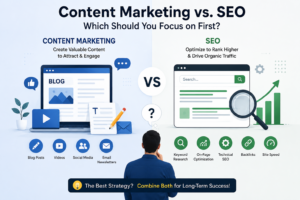
| Content Marketing | SEO |
|---|---|
| Focuses on creating valuable content | Focuses on improving visibility in search engines |
| Builds trust and authority | Increases organic traffic |
| Keeps audiences engaged | Helps users discover your content |
| Encourages sharing and customer loyalty | Improves website rankings |
Content is what people come to read. SEO is how they find it.
Without quality content, SEO has very little to promote. Without SEO, even excellent content may remain hidden.
Which Should You Focus on First?
The answer depends on your situation.
If you are starting a brand-new website
Start with content marketing, but create your content with SEO in mind.
Publishing helpful, informative articles gives search engines something to index. There’s little value in optimizing a website that has only a few pages and little useful content.
Instead, create content that genuinely helps your audience while naturally incorporating relevant keywords.
If your website already has content but gets little traffic
The priority should be SEO.
Improve by:
- Updating outdated information
- Optimizing headings
- Improving page speed
- Adding internal links
- Targeting better keywords
- Writing compelling meta descriptions
If you are running an established business
Don’t choose one over the other.
Successful businesses invest in both. High-quality content attracts visitors, while SEO ensures that content reaches the right audience.
The two strategies work together to create long-term, sustainable growth.
Why Content Marketing and SEO Work Better Together
Imagine building a beautiful library in the middle of a forest with no roads leading to it. The books are excellent, but nobody knows the library exists.
That’s content marketing without SEO.
Now imagine building a highway to an empty building with no books inside.
That’s SEO without content.
The best results happen when you combine valuable content with smart optimization.
For example:
- Research keywords before writing.
- Answer real customer questions.
- Use clear headings.
- Add internal and external links.
- Include images with descriptive alt text.
- Update older articles regularly.
Common Mistakes Beginners Make
Many new website owners unknowingly slow their growth by making avoidable mistakes, such as:
- Stuffing keywords into every paragraph
- Publishing low-quality AI-generated content without editing
- Ignoring user intent
- Writing only for search engines instead of real people
- Forgetting to update old content
- Neglecting mobile optimization
- Failing to measure performance with analytics
A Simple Strategy for Beginners
- Identify the questions your audience is asking.
- Research relevant keywords.
- Create detailed, helpful content.
- Optimize titles, headings, and meta descriptions.
- Publish consistently.
- Share your content on social media and email.
- Monitor your traffic and rankings.
- Update older articles regularly.
This balanced approach allows your content and SEO to strengthen each other.
Final Thoughts
So, should you focus on content marketing or SEO first?
Start with valuable content, but build it using SEO best practices from day one.
Content gives your audience a reason to visit your website. SEO helps them discover it. One attracts people, while the other makes your content visible.
Instead of treating content marketing and SEO as separate strategies, think of them as partners. When combined, they create a strong foundation for sustainable online growth, higher search rankings, and lasting customer relationships.
If you’re serious about growing your website, don’t choose one over the other. Create content your audience loves, optimize it for search engines, and continue improving based on real results. Over time, that consistent effort can become one of your greatest competitive advantages.